 Add to Chrome
 Add to Firefox
 Add to Edge
Boosting Knowledge Graph Foundation Models via Enhanced Negative Sampling
May 26, 2026
Knowledge graphs (KGs) have become the core backbone of numerous downstream tasks such as question answering and recommender systems. However, despite all this, KGs are often very incomplete. To perform zero-shot knowledge graph completion in unseen KGs, which have different relational vocabularies from those used for pre-training, KG foundation models (KGFMs) receive a wide range of attention. Existing KGFMs often perform training using random negative triples, which are constructed by replacing the head or tail entity of a positive triple with a random entity. However, these negative triples are often constructed with limited quality, providing weak supervision for KGFM training. In this paper, we propose a simple yet effective adaptive negative sampling approach, KMAS, to enhance existing KGFMs. KMAS constructs hard negative triples through the updated relation embeddings generated from the existing KGFM's relation encoder. To further adaptively align with the evolving capability of the KGFM during the training process, KMAS adjusts the ratio of hard negative triples dynamically throughout the whole training process: after a warmup phrase, it increases the ratio linearly and then decreases linearly. Extensive experiments are conducted over 44 data sets. Experimental results demonstrate that our proposed negative sampling method can enhance many SOTA KGFMs without requiring excessive additional time or memory consumption.

Phy-CoSF: Physics-Guided Continuous Spectral Fields Reconstruction and Super-Resolution for Snapshot Compressive Imaging
May 13, 2026Recent advances have demonstrated that coded aperture snapshot spectral imaging (CASSI) systems show great potential for capturing 3D hyperspectral images (HSIs) from a single 2D measurement. Despite the inherent spectral continuity of scenes captured by CASSI, most existing reconstruction methods are restricted to fixed, discrete spectral outputs, thereby precluding continuous spectral reconstruction or spectral super-resolution. To address this challenge, we propose Phy-CoSF, which synergizes deep unfolding networks with implicit neural representations, establishing a new paradigm for continuous spectral reconstruction and super-resolution in CASSI. Specifically, we propose a two-phase architecture that bridges discrete-wavelength training with continuous spectral rendering, enabling the synthesis of high-fidelity HSIs at arbitrary target wavelengths. At the core of our framework lies the continuous spectral fields (CoSF) module, embedded within each unfolding stage as a dynamic prior, which comprises a triple-branch cross-domain feature mixer for comprehensive spatial-frequency-channel feature fusion, alongside a spectral synthesis head that generates spectral intensities by querying continuous wavelength coordinates. Extensive experimental results demonstrate that Phy-CoSF not only achieves continuous modeling at arbitrary spectral resolutions but also outperforms many state-of-the-art methods in both reconstruction fidelity and spectral detail preservation. Our code and more results are available at: https://github.com/PaiDii/Phy-CoSF.git.
A Physically-Grounded Attack and Adaptive Defense Framework for Real-World Low-Light Image Enhancement
Mar 15, 2026Limited illumination often causes severe physical noise and detail degradation in images. Existing Low-Light Image Enhancement (LLIE) methods frequently treat the enhancement process as a blind black-box mapping, overlooking the physical noise transformation during imaging, leading to suboptimal performance. To address this, we propose a novel LLIE approach, conceptually formulated as a physics-based attack and display-adaptive defense paradigm. Specifically, on the attack side, we establish a physics-based Degradation Synthesis (PDS) pipeline. Unlike standard data augmentation, PDS explicitly models Image Signal Processor (ISP) inversion to the RAW domain, injects physically plausible photon and read noise, and re-projects the data to the sRGB domain. This generates high-fidelity training pairs with explicitly parameterized degradation vectors, effectively simulating realistic attacks on clean signals. On the defense side, we construct a dual-layer fortified system. A noise predictor estimates degradation parameters from the input sRGB image. These estimates guide a degradation-aware Mixture of Experts (DA-MoE), which dynamically routes features to experts specialized in handling specific noise intensities. Furthermore, we introduce an Adaptive Metric Defense (AMD) mechanism, dynamically calibrating the feature embedding space based on noise severity, ensuring robust representation learning under severe degradation. Extensive experiments demonstrate that our approach offers significant plug-and-play performance enhancement for existing benchmark LLIE methods, effectively suppressing real-world noise while preserving structural fidelity. The sourced code is available at https://github.com/bywlzts/Attack-defense-llie.
Triply Laplacian Scale Mixture Modeling for Seismic Data Noise Suppression
Feb 20, 2025Sparsity-based tensor recovery methods have shown great potential in suppressing seismic data noise. These methods exploit tensor sparsity measures capturing the low-dimensional structures inherent in seismic data tensors to remove noise by applying sparsity constraints through soft-thresholding or hard-thresholding operators. However, in these methods, considering that real seismic data are non-stationary and affected by noise, the variances of tensor coefficients are unknown and may be difficult to accurately estimate from the degraded seismic data, leading to undesirable noise suppression performance. In this paper, we propose a novel triply Laplacian scale mixture (TLSM) approach for seismic data noise suppression, which significantly improves the estimation accuracy of both the sparse tensor coefficients and hidden scalar parameters. To make the optimization problem manageable, an alternating direction method of multipliers (ADMM) algorithm is employed to solve the proposed TLSM-based seismic data noise suppression problem. Extensive experimental results on synthetic and field seismic data demonstrate that the proposed TLSM algorithm outperforms many state-of-the-art seismic data noise suppression methods in both quantitative and qualitative evaluations while providing exceptional computational efficiency.
Learning Nonlocal Sparse and Low-Rank Models for Image Compressive Sensing
Mar 22, 2022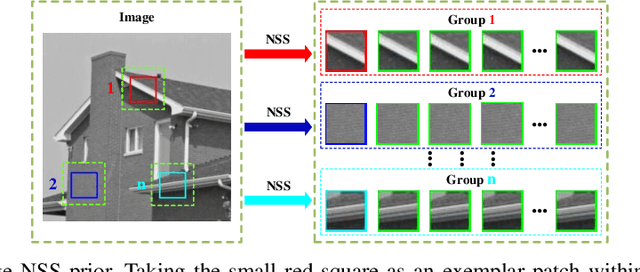
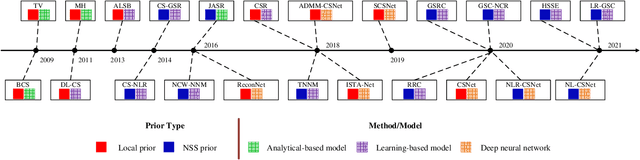
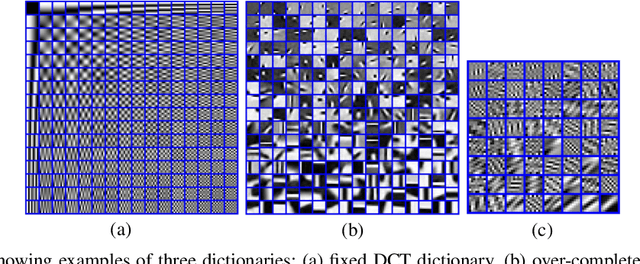
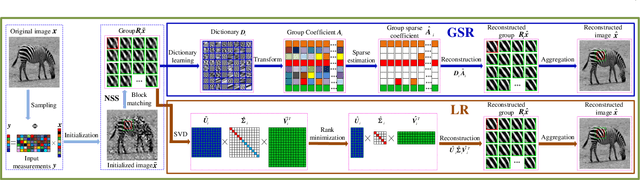
The compressive sensing (CS) scheme exploits much fewer measurements than suggested by the Nyquist-Shannon sampling theorem to accurately reconstruct images, which has attracted considerable attention in the computational imaging community. While classic image CS schemes employed sparsity using analytical transforms or bases, the learning-based approaches have become increasingly popular in recent years. Such methods can effectively model the structures of image patches by optimizing their sparse representations or learning deep neural networks, while preserving the known or modeled sensing process. Beyond exploiting local image properties, advanced CS schemes adopt nonlocal image modeling, by extracting similar or highly correlated patches at different locations of an image to form a group to process jointly. More recent learning-based CS schemes apply nonlocal structured sparsity prior using group sparse representation (GSR) and/or low-rank (LR) modeling, which have demonstrated promising performance in various computational imaging and image processing applications. This article reviews some recent works in image CS tasks with a focus on the advanced GSR and LR based methods. Furthermore, we present a unified framework for incorporating various GSR and LR models and discuss the relationship between GSR and LR models. Finally, we discuss the open problems and future directions in the field.
R3L: Connecting Deep Reinforcement Learning to Recurrent Neural Networks for Image Denoising via Residual Recovery
Jul 12, 2021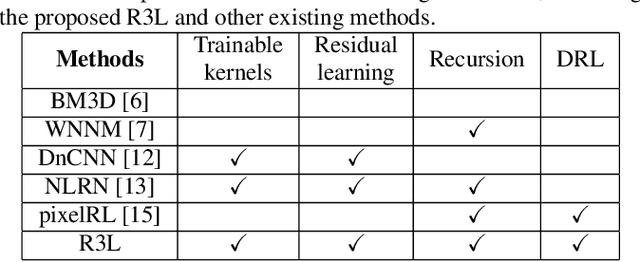
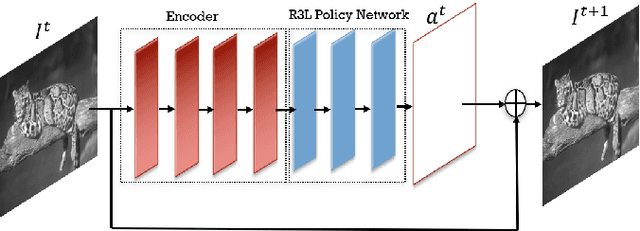
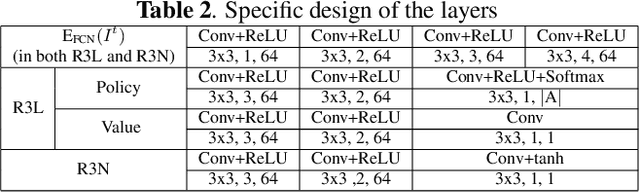
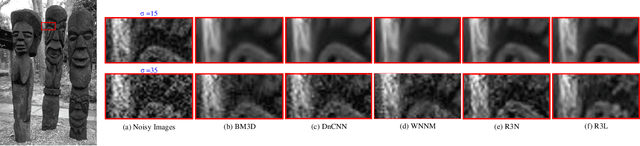
State-of-the-art image denoisers exploit various types of deep neural networks via deterministic training. Alternatively, very recent works utilize deep reinforcement learning for restoring images with diverse or unknown corruptions. Though deep reinforcement learning can generate effective policy networks for operator selection or architecture search in image restoration, how it is connected to the classic deterministic training in solving inverse problems remains unclear. In this work, we propose a novel image denoising scheme via Residual Recovery using Reinforcement Learning, dubbed R3L. We show that R3L is equivalent to a deep recurrent neural network that is trained using a stochastic reward, in contrast to many popular denoisers using supervised learning with deterministic losses. To benchmark the effectiveness of reinforcement learning in R3L, we train a recurrent neural network with the same architecture for residual recovery using the deterministic loss, thus to analyze how the two different training strategies affect the denoising performance. With such a unified benchmarking system, we demonstrate that the proposed R3L has better generalizability and robustness in image denoising when the estimated noise level varies, comparing to its counterparts using deterministic training, as well as various state-of-the-art image denoising algorithms.
The Power of Triply Complementary Priors for Image Compressive Sensing
May 16, 2020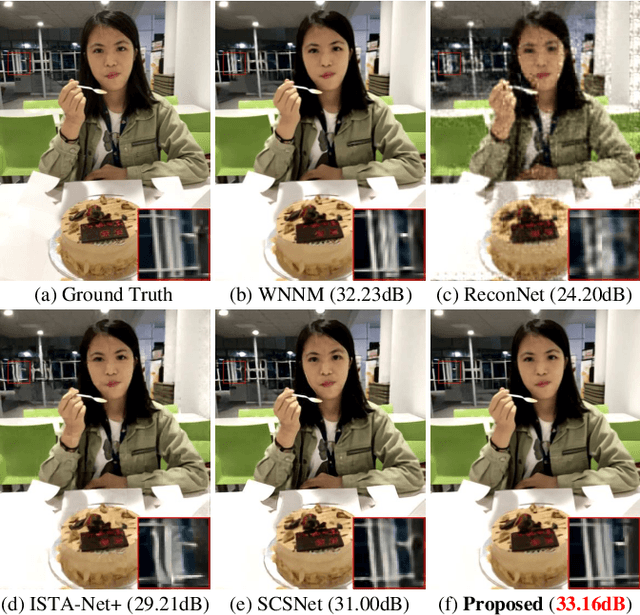


Recent works that utilized deep models have achieved superior results in various image restoration applications. Such approach is typically supervised which requires a corpus of training images with distribution similar to the images to be recovered. On the other hand, the shallow methods which are usually unsupervised remain promising performance in many inverse problems, \eg, image compressive sensing (CS), as they can effectively leverage non-local self-similarity priors of natural images. However, most of such methods are patch-based leading to the restored images with various ringing artifacts due to naive patch aggregation. Using either approach alone usually limits performance and generalizability in image restoration tasks. In this paper, we propose a joint low-rank and deep (LRD) image model, which contains a pair of triply complementary priors, namely \textit{external} and \textit{internal}, \textit{deep} and \textit{shallow}, and \textit{local} and \textit{non-local} priors. We then propose a novel hybrid plug-and-play (H-PnP) framework based on the LRD model for image CS. To make the optimization tractable, a simple yet effective algorithm is proposed to solve the proposed H-PnP based image CS problem. Extensive experimental results demonstrate that the proposed H-PnP algorithm significantly outperforms the state-of-the-art techniques for image CS recovery such as SCSNet and WNNM.
From Rank Estimation to Rank Approximation: Rank Residual Constraint for Image Denoising
Aug 14, 2018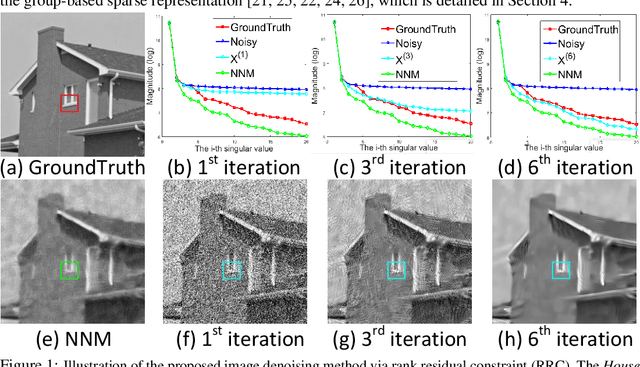
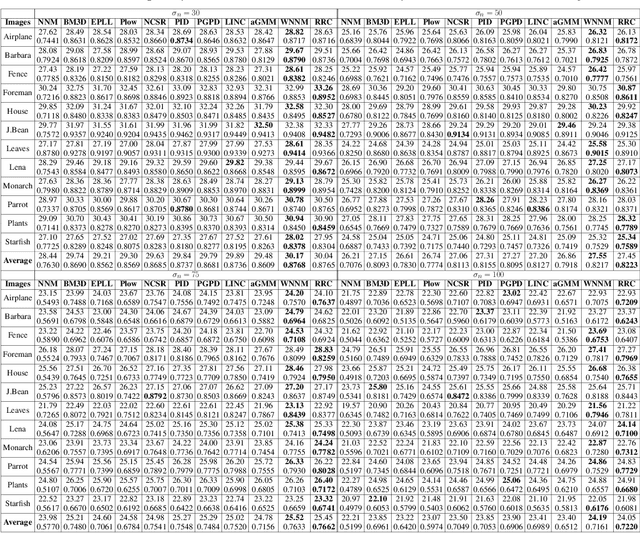
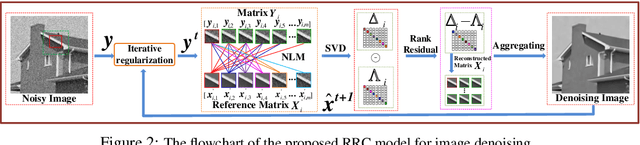
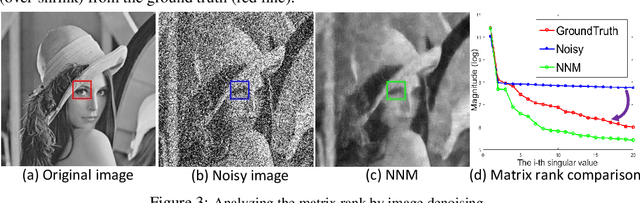
In this paper, we propose a novel approach for the rank minimization problem, termed rank residual constraint (RRC). Different from existing low-rank based approaches, such as the well-known weighted nuclear norm minimization (WNNM) and nuclear norm minimization (NNM), which aim to estimate the underlying low-rank matrix directly from the corrupted observation, we progressively approximate or approach the underlying low-rank matrix via minimizing the rank residual. By integrating the image nonlocal self-similarity (NSS) prior with the proposed RRC model, we develop an iterative algorithm for image denoising. To this end, we first present a recursive based nonlocal means method to obtain a good reference of the original image patch groups, and then the rank residual of the image patch groups between this reference and the noisy image is minimized to achieve a better estimate of the desired image. In this manner, both the reference and the estimated image in each iteration are improved gradually and jointly. Based on the group-based sparse representation model, we further provide a theoretical analysis on the feasibility of the proposed RRC model. Experimental results demonstrate that the proposed RRC model outperforms many state-of-the-art denoising methods in both the objective and perceptual qualities.
Analyzing the Weighted Nuclear Norm Minimization and Nuclear Norm Minimization based on Group Sparse Representation
Jul 19, 2018
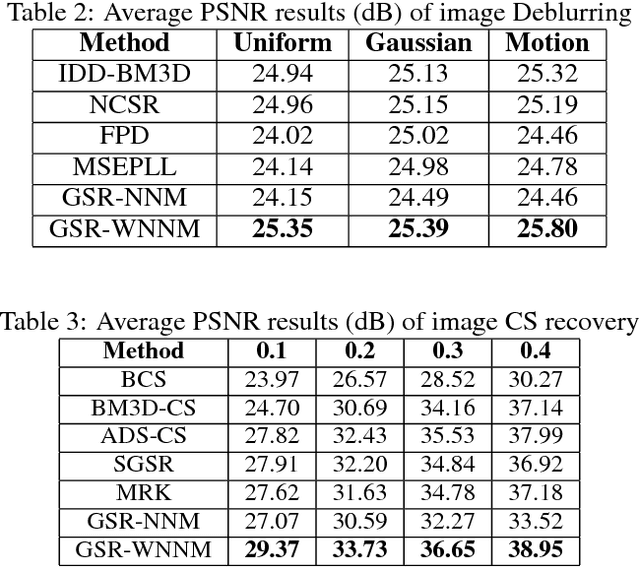
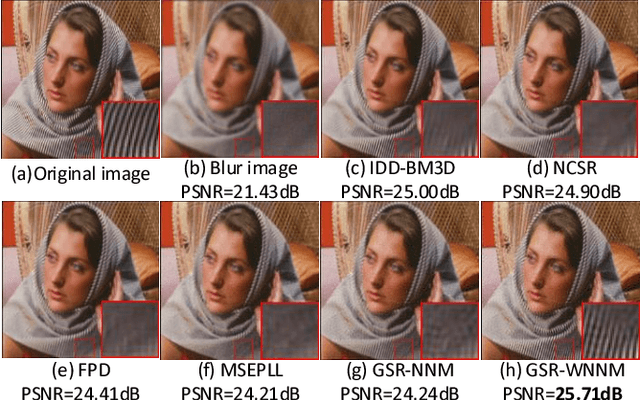
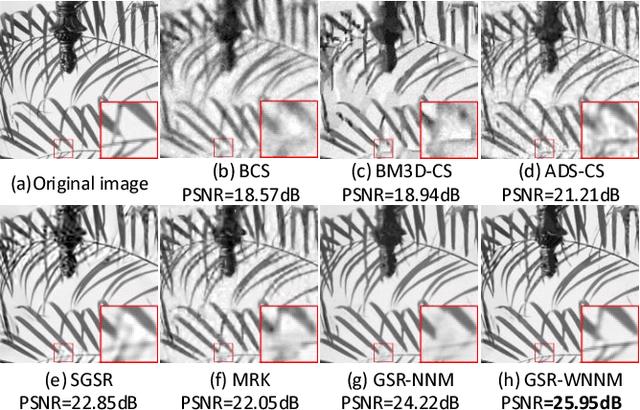
Rank minimization methods have attracted considerable interest in various areas, such as computer vision and machine learning. The most representative work is nuclear norm minimization (NNM), which can recover the matrix rank exactly under some restricted and theoretical guarantee conditions. However, for many real applications, NNM is not able to approximate the matrix rank accurately, since it often tends to over-shrink the rank components. To rectify the weakness of NNM, recent advances have shown that weighted nuclear norm minimization (WNNM) can achieve a better matrix rank approximation than NNM, which heuristically set the weight being inverse to the singular values. However, it still lacks a sound mathematical explanation on why WNNM is more feasible than NNM. In this paper, we propose a scheme to analyze WNNM and NNM from the perspective of the group sparse representation. Specifically, we design an adaptive dictionary to bridge the gap between the group sparse representation and the rank minimization models. Based on this scheme, we provide a mathematical derivation to explain why WNNM is more feasible than NNM. Moreover, due to the heuristical set of the weight, WNNM sometimes pops out error in the operation of SVD, and thus we present an adaptive weight setting scheme to avoid this error. We then employ the proposed scheme on two low-level vision tasks including image denoising and image inpainting. Experimental results demonstrate that WNNM is more feasible than NNM and the proposed scheme outperforms many current state-of-the-art methods.
Group Sparsity Residual with Non-Local Samples for Image Denoising
Mar 22, 2018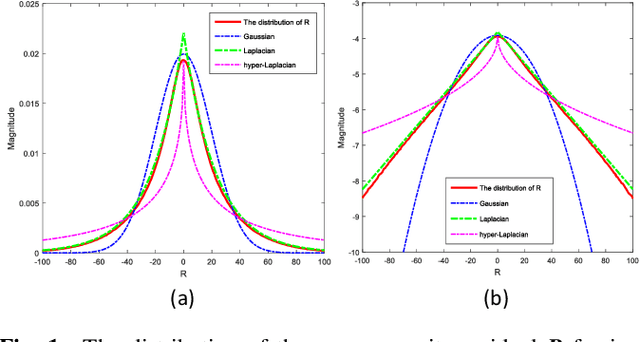
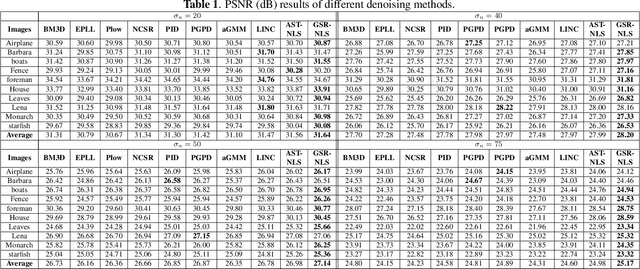


Inspired by group-based sparse coding, recently proposed group sparsity residual (GSR) scheme has demonstrated superior performance in image processing. However, one challenge in GSR is to estimate the residual by using a proper reference of the group-based sparse coding (GSC), which is desired to be as close to the truth as possible. Previous researches utilized the estimations from other algorithms (i.e., GMM or BM3D), which are either not accurate or too slow. In this paper, we propose to use the Non-Local Samples (NLS) as reference in the GSR regime for image denoising, thus termed GSR-NLS. More specifically, we first obtain a good estimation of the group sparse coefficients by the image nonlocal self-similarity, and then solve the GSR model by an effective iterative shrinkage algorithm. Experimental results demonstrate that the proposed GSR-NLS not only outperforms many state-of-the-art methods, but also delivers the competitive advantage of speed.